Gemini, Psychic, Tarot Reading, September, 16, 2019 , Youtube
Tarot carte du jour reading is a form of cartomancy whereby practitioners utilise tarot cards purportedly to proceeds insight into the past, nowadays or hereafter. They codify a question, then describe cards to interpret them for this end. A regular tarot deck consists of 78 cards, which can be split into 2 groups, the Major Arcana and Minor Arcana. French-suited playing cards can also be used; as can any card arrangement with suits assigned to identifiable elements (e.1000., air, earth, burn, h2o).
History [edit]

One of the earliest reference to tarot triumphs, and probably the first reference to tarot as the devil's pic book, is given c. 1450–1470 by a Dominican preacher in a fiery sermon against the evils of the devil'southward musical instrument.[1] References to the tarot equally a social plague continue throughout the 16th and 17th centuries, but there are no indications that the cards were used for anything but games anywhere other than in Bologna.[two] As philosopher and tarot historian Michael Dummett noted, "it was simply in the 1780s, when the practice of fortune-telling with regular playing cards had been well established for at least ii decades, that anyone began to employ the tarot pack for cartomancy."[3]
The belief in the divinatory meaning of the cards is closely associated with a belief in their occult backdrop: a commonly held belief in the 18th century propagated by prominent Protestant clerics and freemasons.[3] One of them was Court de Gébelin (see below).
From its uptake as an instrument of prophecy in France, the tarot went on to be used in hermeneutic, magical, mystical,[iv] semiotic,[5] and psychological practices. It was used by Romani people when telling fortunes,[half dozen] as a Jungian psychological appliance capable of borer into "absolute knowledge in the unconscious",[seven] a tool for archetypal analysis,[8] and even a tool for facilitating the Jungian process of individuation.[nine] [ten]
Court de Gébelin [edit]
Many involved in occult and divinatory practices attempt to trace the tarot to aboriginal Egypt, divine hermetic wisdom,[xi] and the mysteries of Isis.
Peradventure the first of those was Antoine Courtroom de Gébelin, a French clergyman, who wrote that after seeing a group of women playing cards he had the idea that tarot was non merely a game of cards but was in fact of ancient Egyptian origin, of mystical Qabalistic import, and of deep divine significance. Court de Gébelin published a dissertation on the origins of the symbolism in the tarot in volume VIII of work Le Monde primitif in 1781. He thought the tarot represented ancient Egyptian Theology, including Isis, Osiris and Typhon. For case, he thought the card he knew every bit the Papesse and known today equally the Loftier Priestess represented Isis.[12] He also related 4 tarot cards to the four Christian Central virtues: Temperance, Justice, Force and Prudence.[13] He relates The Tower to a Greek fable virtually avarice.[14]
Although the ancient Egyptian language had not yet been deciphered, Courtroom de Gébelin asserted the name "Tarot" came from the Egyptian words Tar, "path" or "route", and the word Ro, Ros or Rog, pregnant "Rex" or "royal", and that the tarot literally translated to the Royal Route of Life.[15] Later Egyptologists found nothing in the Egyptian language to support Court de Gébelin's etymologies.[ commendation needed ] Despite this lack of whatever show, the belief that the tarot cards are linked to the Egyptian Volume of Thoth continues to the present twenty-four hour period.
The bodily source of the occult tarot can be traced to two articles in book viii, i written by himself, and one written by M. le C. de M.***.[a] The second has been noted to accept been fifty-fifty more influential than Courtroom de Gébelin'south.[2] The author takes Courtroom de Gébelin's speculations even further, agreeing with him about the mystical origins of the tarot in ancient Egypt, but making several boosted, and influential, statements that continue to influence mass understanding of the occult tarot fifty-fifty to this day.[xvi] He made the first statements proposing that the tarot was "The Book of Thoth" and made the first clan of tarot with cartomancy. Court de Gébelin was likewise the starting time to imply the being of a connectedness betwixt the tarot and the Romani people, although this connection did not become well established in the public consciousness until other French authors such every bit Boiteau d'Ambly and Jean-Alexandre Vaillant began in the 1850s to promote the theory that tarot cards had been brought to Europe by the Romani.[17] [xviii]
Etteilla [edit]
The get-go to assign divinatory meanings to the tarot cards was cartomancer Jean-Baptiste Alliette (also known equally Etteilla) in 1783.[19] [xx]
According to Dummett, Etteilla:[2]
- devised a method of tarot divination in 1783,
- wrote a cartomantic treatise of tarot as the Book of Thoth,
- created the first guild for tarot cartomancy, the Société littéraire des associés libres des interprètes du livre de Thot.
- created the first corrected tarot (supposedly fixing errors that resulted from misinterpretation and corruption through the mists of antiquity), The G Etteilla deck
- created the beginning Egyptian tarot to exist used exclusively for tarot cartomancy, and
- published, under the banner of his society, the Dictionnaire synonimique du Livre de Thot, a book that "systematically tabulated all the possible meanings which each card could bear, when upright and reversed."[21]
Etteilla likewise:[22]
- suggested that tarot was repository of the wisdom of Hermes Trismegistus
- was a book of eternal medicine
- was an account of the cosmos of the world, and
- argued that the first copy of the tarot was imprinted on leaves of gilded
In his 1980 book, The Game of Tarot, Michael Dummett suggested that Etteilla was attempting to supplant Courtroom de Gébelin as the author of the occult tarot.[ citation needed ] Etteilla in fact claimed to take been involved with tarot longer than Court de Gébelin.[ii]
Marie Anne Lenormand [edit]
Mlle Marie-Anne Adelaide Lenormand outshone even Etteilla and was the first cartomancer to people in high places, through her claims to exist the personal confidant of Empress Josephine, Napoleon and other notables.[2] Lenormand used both regular playing cards, in particular the Piquet pack, as well as tarot cards likely derived from the Tarot de Marseille.[23] Post-obit her expiry in 1843, several different cartomantic decks were published in her name, including the Grand Jeu de Mlle Lenormand, based on the standard 52-card deck, first published in 1845, and the Petit Lenormand, a 36-carte deck derived from the High german game Das Spiel der Hofnung, first published effectually 1850.[24]
Éliphas Lévi [edit]
The concept of the cards every bit a mystical primal was extended by Éliphas Lévi. Lévi (whose actual name was Alphonse-Louis Abiding) was educated in the seminary of Saint-Sulpice, was ordained as a deacon, just never became a priest. Michael Dummett noted that it is from Lévi's book Dogme et rituel that the "whole of the modern occultist motion stems."[25] Lévi'due south magical theory was based on a concept he called the Astral Light[26] and according to Dummett, he claimed to be the first to:[27]
- "have discovered intact and still unknown this primal of all doctrines and all philosophies of the quondam globe... without the tarot", he tells us, "the Magic of the ancients is a closed book...."
Lévi accepted Court de Gébelin'due south claims that the deck had an Egyptian origin, but rejected Etteilla's interpretation and rectification of the cards in favor of a reinterpretation of the Tarot de Marseille.[28] He called information technology The Book of Hermes and claimed that the tarot was antique, existed before Moses, and was in fact a universal primal of erudition, philosophy, and magic that could unlock Hermetic and Qabalistic concepts.[ citation needed ] According to Lévi, "An imprisoned person with no other book than the Tarot, if he knew how to use it, could in a few years larn universal knowledge, and would exist able to speak on all subjects with unequaled learning and inexhaustible eloquence."[29]
According to Dummett, Lévi's notable contributions included the post-obit:[thirty]
- Lévi was the commencement to advise that the Magus (Bagatto) was to exist depicted in conjunction with the symbols of the four suits.
- Inspired by de Gébelin, Lévi associated the Hebrew alphabet with the Major Arcana (tarot trumps) and attributed an "onomantic astrology" system to the "aboriginal Hebrew Qabalists."[31]
- Lévi linked the ten numbered cards in each suit to the 10 sefiroth.
- He claimed the court cards represented stages of human life.
- He also claimed the four suits represented the Tetragrammaton.
French Tarot after Lévi [edit]
Occultists, magicians, and magi all the manner down to the 21st century have cited Lévi as a defining influence.[32] [b] Among the first to seemingly adopt Lévi'south ideas was Jean-Baptiste Pitois. Pitois wrote two books under the name Paul Christian that referenced the tarot, L'Homme rouge des Tuileries (1863), and later Histoire de la magie, du monde surnaturel et de la fatalité à travers les temps et les peuples (1870). In them, Pitois repeated and extended the mythology of the tarot and changed the names for the trumps and the suits (see table below for a list of Pitois's modifications to the trumps).[33] Batons (wands) become Scepters, Swords get Blades, and Coins become Shekels.[c]
Notwithstanding, it wasn't until the late 1880s that Lévi'due south vision of the occult tarot truly began to deport fruit, equally his ideas on the occult began to be propounded by diverse French and English language occultists. In France, secret societies such as the French Theosophical Society (1884) and the Kabbalistic Lodge of the Rose-Cross (1888) served as the seeds for further developments in the occult tarot in France.[34]
The French occultist Papus was i of the nigh prominent members of these societies, joining the Isis guild of the French Theosophical Society in 1887 and becoming a founding member of the Kabbalistic Order of the Rose-Cross the next year.[34] Amid his 260 publications are two treatises on the use of tarot cards, Le Tarot des Bohémiens (1889), which attempted to formalize the method of using tarot cards in ceremonial magic first proposed past Lévi in his Clef des grands mysteries (1861),[35] and Le Tarot divinatoire (1909), which focused on simpler divinatory uses of the cards.[36]
Another founding member of the Kabbalistic Lodge of the Rose-Cross, the Marquis Stanislas de Guaita, met the apprentice creative person Oswald Wirth in 1887 and later on sponsored a production of Lévi's intended deck. Guided entirely by de Guaita, Wirth designed the first neo-occultist cartomantic deck (and first cartomantic deck non derived from Etteilla'south Egyptian deck).[37] Released in 1889 as Les 22 Arcanes du Tarot kabbalistique, information technology consisted of only the xx-two major arcana and was revised under the championship of Le Tarot des imagers du moyen âge in 1926. [38] Wirth besides released a book about his revised cards which contained his own theories of the occult tarot under the same title the year following.[39]
Outside of the Kabbalistic Order, in 1888, French magus Ély Star published Les mystères de 50'horoscope which mostly repeats Christian's modifications.[40] Its primary contribution was the introduction of the terms 'Major Arcana' and 'Pocket-size Arcana', and the numbering of the Crocodile (the Fool) XXII instead of 0.[41]
The Hermetic Club of the Gold Dawn and its heirs [edit]
The belatedly 1880s not simply saw the spread of the occult tarot in France, but likewise its initial adoption in the English-speaking world. In 1886, Arthur Edward Waite published The Mysteries of Magic, a selection of Lévi's writings translated by Waite and the first pregnant treatment of the occult tarot to exist published in England.[42] All the same, it was just through the establishment of the Hermetic Guild of the Golden Dawn in 1888 that the occult tarot was to get established as a tool in the English language-speaking earth.
Of the three founding members of the Golden Dawn, two, Samuel Liddell Mathers and William Wynn Westcott, published texts relating to the occult tarot prior to the founding of the guild. Westcott is known to have made ink sketches of tarot trumps in or effectually 1886[43] and discussed the tarot in his treatise Tabula Bembina, sive Mensa Isiaca, published in 1887,[44] while Mathers had published the starting time British piece of work primarily focused on the tarot in his 1888 booklet entitled The Tarot: Its Occult Signification, Use in Fortune-Telling and Method of Play.[45]
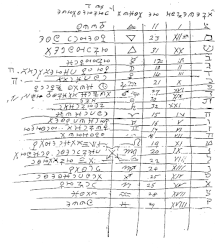
The tarot was likewise mentioned explicitly in the Cypher Manuscripts that served every bit the founding document of the Hermetic Order, both implicitly and in the grade of a separate essay accompanying the manuscript.[46] This essay was to serve equally the ground for most of tarot interpretations by the Golden Dawn and its immediate successors, including such features as:[47]
- placing The Fool before the other 21 trumps when determining the Qabalistic correspondence of the Major Arcana to the Hebrew alphabet
- attributing the Hebrew alphabet correspondences to pathways in the Tree of Life
- swapping the positions of the eighth and eleventh arcana (Justice and Force), and
- reassigning Qabalistic planetary associations to accord with the re-ordered trumps
The Golden Dawn also:[48]
- renamed the suits of Batons and Coins to Wands and Pentacles
- swapped the order of the King and the Knight among the court cards
- renaming them the Prince and the King, respectively
- changed the Folio to become the Princess
- assigned each of the courtroom cards, likewise, to the letters of the Tetragrammaton, thus associating both the court cards and suits to the four classical elements,[48] and
- associated each of the 36 cards ranked from 2 to 10, inclusive, with one of the 36 astrological decans
The Hermetic Order never released its own tarot deck for public utilise, preferring instead for members to create their ain copies of a deck designed by Mathers with art by his wife, Moina Mathers.[49] [d] However, many of these innovations would make their showtime public appearance in two influential tarot decks designed by members of the gild: the Rider–Waite–Smith deck and the Thoth deck. In add-on, occultist Israel Regardie involved himself in 2 separate recreations of the original Gold Dawn deck, the Golden Dawn Tarot of 1978 with fine art by Robert Wang, and the New Gold Dawn Ritual Tarot [e] by Chic and Sandra Cicero, released, after Regardie'southward death, in 1991.[53] The central document containing the Aureate Dawn'southward Tarot interpretations, "Book T", was kickoff published openly, if not under that championship, by Aleister Crowley in his occult periodical The Equinox in 1912.[54] [55] The volume was later republished independently in 1967.[56]
| Tarot card | Hebrew alphabetic character | Element/planet/sign |
|---|---|---|
| 0 The Fool | א Aleph | 🜁 Air |
| I The Magician | ב Bet | ☿ Mercury |
| Two The High Priestess | ג Gimel | ☾ Moon |
| 3 The Empress | ד Dalet | ♀ Venus |
| Four The Emperor | ה He | ♈︎ Aries |
| V The Hierophant | ו Vau | ♉︎ Taurus |
| Vi The Lovers | ז Zayin | ♊︎ Gemini |
| VII The Chariot | ח Heth | ♋︎ Cancer |
| VIII Forcefulness | ט Teth | ♌︎ Leo |
| IX The Hermit | י Yod | ♍︎ Virgo |
| X Cycle of Fortune | כ Kaph | ♃ Jupiter |
| XI Justice | ל Lamed | ♎︎ Libra |
| XII The Hanged Man | מ Mem | 🜄 Water |
| 13 Decease | נ Nun | ♏︎ Scorpio |
| Fourteen Temperance | ס Samekh | ♐︎ Sagittarius |
| XV The Devil | ע Ayin | ♑︎ Capricorn |
| XVI The Tower | פ Pe | ♂ Mars |
| XVII The Star | צ Tsade | ♒︎ Aquarius |
| XVIII The Moon | ק Qoph | ♓︎ Pisces |
| XIX The Dominicus | ר Resh | ☉ Sun |
| 20 Judgement | ש Shin | 🜂 Fire |
| XXI The World | ת Taw | ♄ Saturn |
Waite and Crowley [edit]

The Celtic Cross Spread using the Rider–Waite–Smith deck
The Rider–Waite–Smith deck,[f] released in 1909, was the first complete cartomantic tarot deck other than those derived from Etteilla's Egyptian tarot.[58] (Oswald Wirth's 1889 deck had only depicted the major arcana.[37]) The deck, designed by Arthur Edward Waite, was executed past Pamela Colman Smith, a fellow Golden Dawn member, and was the first tarot deck to characteristic complete scenes for each of the 36 suit cards between 2 and 10 since the Sola Busca tarot of the 15th century, with designs very probably based in part on a number of photographs of them held by the British Museum.[59] The deck followed the Golden Dawn in its choice of adjust names and in swapping the order of the trumps of Justice and Strength, only essentially preserved the traditional designations of the court cards. The deck was followed past the release of The Key to the Tarot, also by Waite, in 1910.[thousand]
The Thoth deck, first released as part of Aleister Crowley's The Book of Thoth in 1944,[60] stand for a somewhat different development of the original Golden Dawn designs. The deck, executed by Lady Frieda Harris as a serial of paintings between 1938 and 1942,[61] owes much to Crowley's development of Thelema in the years following the dissolution of the Hermetic Order. While the deck follows Aureate Dawn teachings with respect to the zodiacal associations of the major arcana and the associations of the minor arcana with the various astrological decans, it as well:[62]
- reverted to the traditional Marseille numbering of Justice and Strength as arcana 8 and 11, respectively (though information technology retained the swapped associations with respect to the Hebrew alphabet)
- swapped the Hebrew alphabet associations of the fourth and seventeenth arcana (The Emperor and The Star, respectively), in accordance with Crowley's Liber Legis of 1913
- renamed several of the major arcana
- renamed the suits of Batons and Coins to Wands and Disks (the latter instead of the Golden Dawn's "Pentacles"), and
- adopted the Gold Dawn's courtroom cards, except that the Knight was not renamed
While Crowley managed to print a fractional test run of the standalone deck using vii color plates included in The Volume of Thoth, information technology was non until the 1960s, after Crowley and Harris's deaths, that the deck was first printed in its entirety.[60]
Tarot in the United States [edit]
Two of the earliest publications on tarot in the English were published in the United States, including a volume by Madame Camille Le Normand entitled Fortune-Telling past Cards; or, Cartomancy Made Like shooting fish in a barrel, published in 1872,[63] and an bearding American essay on the tarot published in The Platonist in 1885 entitled "The Taro".[64] The latter essay is implied by Decker and Dummett to have been written by an individual with a connexion to the occult order known equally the Hermetic Brotherhood of Luxor.[65] While it is not clear to what extent the Hermetic Brotherhood used tarot cards in its practices,[66] information technology was to influence later occult societies such as Elbert Benjamine'due south Church of Low-cal, which had tarot practices (and an accompanying deck) of its own.[67]
Adoption of the esoteric tarot practices of the Golden Dawn in the U.s.a. was driven in part past the American occultist Paul Foster Case, whose 1920 book An Introduction to the Study of the Tarot made use of the Rider–Waite–Smith deck and assorted esoteric associations first adopted by the Golden Dawn.[68] By the 1930s, however, Example had formed his ain occult lodge, the Builders of the Adytum, and began to promote the Revised New Art Tarot,[h] past Manly P. Hall with fine art by J. Augustus Knapp,[69] as well equally Case'southward own deck. Executed by Jessie Burns Parke, the artwork of Case's deck, the B.O.T.A. Tarot, more often than not resembles that of the Passenger–Waite–Smith deck, but the deck as well shows influences from Oswald Wirth and the original design of the Hermetic Order of the Golden Dawn tarot.[seventy] Instance promoted the deck in his 1947 book The Tarot: A Key to the Wisdom of the Ages, which also marked one of the offset references to the work of Carl Jung past a tarotist.[71]
Esoteric use of the Rider–Waite–Smith Tarot was also promoted in the works of Eden Gray, whose three books on the tarot made extensive utilise of the deck. Gray'due south books were adopted by members of the 1960s counter-culture as standard reference works on divinatory use of tarot cards,[72] and her 1970 book A Complete Guide to the Tarot was the first work to use the metaphor of the "Fool's Journey" to explain the meanings of the major arcana.[73] [74]
Tarot since 1970 [edit]
The work of Eden Gray and others in the 1960s led to an explosion of popularity in tarot carte reading beginning in 1969.[56] Stuart R. Kaplan's U.Southward. Games Systems, which had been founded in 1968 to import copies of the Swiss 1JJ Tarot, was well positioned to take advantage of this explosion and reissued the then out-of-print Passenger–Waite–Smith Tarot in 1970, which has not gone out of print since.[75] Tarot bill of fare reading apace became associated with New Age thought, signaled in part past the popularity of David Palladini's Passenger–Waite–Smith-inspired Aquarian Tarot, first issued in 1968.[76] Artists shortly began to create their own interpretations of the tarot for creative purposes rather than purely esoteric ones, such as the Mount Dream Tarot of Bea Nettles, the first photographic tarot deck, released in 1975.[77]
The 1980s and 1990s saw the rising of a new generation of tarotists, influenced by the writings of Eden Grayness and the work of Carl Jung and Joseph Campbell on psychological archetypes. These tarotists sought to use tarot card reading to personal introspection and growth, and included Mary Yard. Greer, the author of Tarot for Your Self: A Wookbook for the Inward Journey (1984), and Rachel Pollack, the author of Seventy-Eight Degrees of Wisdom (1980/1983).[78] [79] Tarot cards besides began to proceeds popularity every bit a divinatory tool in countries like Japan, where hundreds of new decks have been designed in contempo years.[fourscore] The democratization of digital publishing in the 2000s and 2010s led to a new explosion of tarot decks as artists became increasingly able to self-publish their own, with the contemporaneous empowerment of feminist, LGBTQ+ and other marginalized communities providing a set up market place for such work.[81] [82]
Use [edit]
Tarot is often used in conjunction with the study of the Hermetic Qabalah.[83] In these decks all the cards are illustrated in accordance with Qabalistic principles, nigh being influenced by the Rider–Waite deck. Its images were fatigued past artist Pamela Colman Smith, to the instructions of Christian mystic and occultist Arthur Edward Waite and published in 1911.[84] A divergence from Marseilles way decks is that Waite and Smith use scenes with esoteric meanings on the suit cards. These esoteric, or divinatory meanings were derived in great role from the writings of the Hermetic Order of the Golden Dawn grouping, of which Waite had been a member. The meanings[85] and many of the illustrations[86] showed the influence of astrology as well every bit Qabalistic principles.
Trumps [edit]
The following is a comparison of the society and names of the Major Trumps up to and including the Rider–Waite–Smith and Crowley (Thoth) decks:
| Tarot de Marseille[87] | Courtroom de Gébelin[88] | Etteilla[89] | Paul Christian[xc] | Oswald Wirth[91] | Gilded Dawn[92] | Rider–Waite–Smith[93] | Volume of Thoth (Crowley)[94] |
|---|---|---|---|---|---|---|---|
| I. The Juggler | I. The Thimblerig, or Bateleur | 15. Illness | I. The Magus | 1. The Wizard | I. The Sorcerer | I. The Sorcerer | I. The Magus[i] |
| 2. The Popess | II. The High Priestess | eight. Etteilla /Female questioner | 2. The Gate of the Sanctuary (of the occult Sanctuary) | 2. The Priestess | Ii. The High Priestess | 2. The Loftier Priestess | 2. The Priestess |
| Iii. The Empress | Three. The Queen | six. Night /Mean solar day | III. Isis-Urania | 3. The Empress | 3. The Empress | III. The Empress | III. The Empress |
| IV. The Emperor | IV. The King | vii. Support /Protection | IV. The Cubic Stone | 4. The Emperor | IV. The Emperor | Four. The Emperor | 4. The Emperor |
| V. The Pope | V. The Pb Hierophant, or the Loftier Priest | 13. Spousal relationship /Union | V. The Primary of the Mysteries (of the Arcana) | 5. The Pope | Five. The Hierophant | V. The Hierophant | V. The Hierophant |
| Vi. The Lovers | 6. The Matrimony | (none)[j] | VI. The Two Roads | 6. The Lover | VI. The Lovers | VI. The Lovers | VI. The Lovers |
| Vii. The Chariot | 7. Osiris Triumphant | 21. Dissension | VII. The Chariot of Osiris | vii. The Chariot | 7. The Chariot | 7. The Chariot | 7. The Chariot |
| VIII. Justice | VIII. Justice | 9. Justice /Jurist | Viii. Themis (the Scales and Blade) | eight. Justice | XI. Justice | 11. Justice | 8. Adjustment |
| 9. The Hermit | Nine. The Sage, or the Seeker of Truth and Justice | 18. Traitor | IX. The Veiled Lamp | ix. The Hermit | IX. The Hermit | Ix. The Hermit | IX. The Hermit |
| 10. The Bicycle of Fortune | X. The Wheel of Fortune | 20. Fortune /Increase | Ten. The Sphinx | ten. The Bicycle of Fortune | X. The Bike of Fortune | X. Cycle of Fortune | X. Fortune |
| XI. Strength | XI. Strength | eleven. Force /Sovereign | XI. The Muzzled Lion (the Tamed Lion) | xi. The Forcefulness | VIII. Strength | VIII. Forcefulness | XI. Lust |
| XII. The Hanged Man | XII. Prudence | 12. Prudence /The People | XII. The Cede | 12. The Hanged Man | XII. The Hanged Human | XII. The Hanged Human | XII. The Hanged Homo |
| Thirteen. Death[1000] | XIII. Expiry[fifty] | 17. Mortality /Pettiness | Xiii. The Skeleton Reaper (the Reaper, the Scythe) | 13. Death | 13. Decease | XIII. Death | 13. Death |
| Xiv. Temperance | Xiv. Temperance[l] | x. Temperance /Priest | Xiv. The Two Urns (the Genius of the Sun) | 14. Temperance | XIV. Temperance | XIV. Temperance | XIV. Art |
| Fifteen. The Devil | Fifteen. Typhon | 14. Great Force | Fifteen. Typhon | xv. The Devil | 15. The Devil | XV. The Devil | XV. The Devil |
| XVI. The House of God | XVI. God-House, or Castle of Plutus | 19. Misery /Prison | 16. The Beheaded Tower (the Lightning-Struck Tower) | 16. The Belfry | Sixteen. The Blasted Tower | XVI. The Tower | Xvi. The Tower |
| XVII. The Star | XVII. The Dog Star | 4. Desolation /Air | XVII. The Star of the Magi | 17. The Star | XVII. The Star | XVII. The Star | XVII. The Star |
| XVIII. The Moon | Xviii. The Moon | 3. Comments /H2o | Eighteen. The Twilight | 18. The Moon | Eighteen. The Moon | 18. The Moon | XVIII. The Moon |
| XIX. The Dominicus | XIX. The Sun | 2. Enlightenment /Fire | XIX. The Blazing Light | 19. The Sun | 19. The Lord's day | Xix. The Sun | Xix. The Sun |
| Xx. Judgement | XX. The Last Judgment | 16. Judgment | Twenty. The Enkindling of the Dead (the Genius of the Dead) | twenty. Judgment | Twenty. Sentence | XX. Judgement | Xx. The Aeon |
| XXI. The Earth | XXI. Fourth dimension | five. Voyage /Earth | XXI. The Crown of the Magi | 21. The World | XXI. The Universe | XXI. The World | XXI. The Universe |
| — The Fool | 0. The Fool | 78 (or 0). Folly | 0. The Crocodile[m] | — The Fool[n] | 0. The Fool | 0. The Fool[o] | 0. The Fool |
Personal use [edit]
Next to the usage of tarot cards to divine for others past professional cartomancers, tarot is also used widely equally a device for seeking personal guidance and spiritual growth. Practitioners frequently believe tarot cards tin can assist the individual explore 1's spiritual path.
People who utilise the tarot for personal divination may seek insight on topics ranging widely from wellness or economic issues to what they believe would be best for them spiritually.[100] Thus, the manner practitioners utilise the cards in regard to such personal inquiries is field of study to a variety of personal behavior. For instance, some tarot users may believe the cards themselves are magically providing answers, while others may believe a supernatural force or a mystical energy is guiding the cards into a layout.
Alternatively, some practitioners believe tarot cards may be utilized as a psychology tool based on their archetypal imagery, an thought often attributed to Carl Jung. Jung wrote, "Information technology as well seems every bit if the set of pictures in the Tarot cards were distantly descended from the archetypes of transformation, a view that has been confirmed for me in a very enlightening lecture by Professor Bernoulli."[101] During a 1933 seminar on active imagination, Jung described the symbolism he saw in the imagery:[102]
The original cards of the Tarot consist of the ordinary cards, the rex, the queen, the knight, the ace, etc., merely the figures are somewhat unlike, and besides, there are 20-one [additional] cards upon which are symbols, or pictures of symbolical situations. For example, the symbol of the sun, or the symbol of the man hung upwards past the feet, or the tower struck by lightning, or the wheel of fortune, and and so on. Those are sort of archetypal ideas, of a differentiated nature, which mingle with the ordinary constituents of the flow of the unconscious, and therefore information technology is applicable for an intuitive method that has the purpose of understanding the period of life, possibly fifty-fifty predicting future events, at all events lending itself to the reading of the conditions of the present moment.
Criticism [edit]
Skeptic James Randi once said that:[103]
For apply as a divinatory device, the tarot deck is dealt out in various patterns and interpreted by a gifted "reader." The fact that the deck is not dealt out into the same blueprint 15 minutes later is rationalized by the occultists past claiming that in that short bridge of time, a person's fortune can change, too. That would seem to call for rather frequent readings if the system is to be of any use whatsoever.
Tarot historian Michael Dummett similarly critiqued occultist uses throughout his various works, remarking that "the history of the esoteric apply of Tarot cards is an oscillation between the two poles of vulgar fortune telling and high magic; though the fence between them may have collapsed in places, the story cannot be understood if nosotros neglect to discern the difference betwixt the regions it demarcates."[104] As a historian, Dummett held detail disdain for what he called "the near successful propaganda campaign always launched", noting that "an entire simulated history, and fake interpretation, of the Tarot pack was concocted by the occultists; and it is all merely universally believed."[105]
Readings are entity-agnostic and time-independent. Technically, in all probability, any tarot bill of fare spread is meant for its audience (the watcher) when received. This is contrary to the belief that certain persons (i.e., astrological signs) are given specialized readings. For instance, a reader on YouTube may mail a spread for 'Capricorn, Jan 20xx', still, anybody viewing that video should exist able to deduce something from those energies.
Some religious groups discourage divination, including tarot card reading. Leviticus 19:26 and Deuteronomy 18:9–12 have been cited every bit proof texts on this subject by Christian writers.[ who? ] Other groups may be accepting of at least some forms of tarot reading.[ commendation needed ]
Come across likewise [edit]
- List of topics characterized as pseudoscience
- Pocket-sized Arcana (the 56 suit cards)
- Major Arcana (the 22 trumps)
- Psychic reading
- Rider–Waite tarot deck
Notes [edit]
- ^ The asterisks and the abbreviations are the actual mode Court de Gébelin refers to the second essay. As Dummett (1980) notes, Robin Briggs identifies the contributor as Louis-Raphael-Lucrece de Fayolle, Comte de Mellet. Louis was a brigadier, governor, and "unremarkable courtroom noble."
- ^ Waite (2005) made 34 references to Lévi in all, including references to five of Lévi's books in the bibliography.
- ^ Dummett (1980) singles out Pitois'southward writing as one of the worst examples of what he calls faux ascription to be found in the occult literature.
- ^ No complete copies of this deck are known to exist, merely copies of three trumps, one court card, and the entire set up of minor arcana painted by Moina Mathers were preserved by the Whare Ra Temple of New Zealand, and a fix of court cards believed to be those of Due west. W. Westcott were also preserved. Israel Regardie'southward later on recreations of the deck were based on colour photocopies of his personal deck for which the originals had been stolen.[50] [51]
- ^ Rereleased equally the Golden Dawn Magical Tarot in 2000 and 2010.[52]
- ^ Alternately named the Rider–Waite Tarot or Waite–Smith Tarot
- ^ Re-released with black-and-white versions of Smith'south artwork as The Pictorial Cardinal to the Tarot, in 1911.
- ^ Also known as the Knapp Tarot or Knapp-Hall Tarot
- ^ Some versions of Crowley'due south tarot include two additional variants of this arcanum with unlike artwork.[95] [60]
- ^ Just annotation that Revak identifies a single carte du jour labeled "1. Etteilla/Male querent" that does non correspond to any in the Tarot de Marseille.
- ^ Typically unlabeled.
- ^ a b Court de Gébelin incorrectly labeled both Decease and Temperance as Thirteen.[96] The latter is probably a printing mistake.
- ^ Christian, post-obit Lévi, placed his "Crocodile" betwixt Arcanum Twenty and Arcanum XXI.
- ^ Wirth typically placed his unnumbered "Fool" last, only depicted the penultimate Hebrew letter shin (ש) on the card, following Lévi'south arrangement of Arcanum 0 between Arcanum XX and Arcanum XXI.[97] [98]
- ^ While the Fool is numbered 0 in the Rider–Waite–Smith tarot, Waite follows Lévi in listing it betwixt Arcanum XX and Arcanum XXI in his Pictorial Fundamental to the Tarot, despite calling such an order "ridiculous on the surface [and] incorrect on the symbolism".[99]
References [edit]
- ^ Steele, Robert (1900). "A notice of the Ludus Triumphorum and Some Early Italian Menu Games: With Some Remarks on the Origin of the Game of Cards". Archaeologia. LVII: 85–200. doi:ten.1017/S0261340900027636.
- ^ a b c d e Dummett 1980, p.[ folio needed ].
- ^ a b Dummett 1980, p. 96.
- ^ Ouspensky, P. D. (1976). The Symbolism of the Tarot: philosophy of occultism in pictures and numbers. Dover Publications.
- ^ Semetsky, Inna (2011). "Tarot images and spiritual education: the three I's model". International Journal of Children's Spirituality. 16 (three): 249–260. doi:10.1080/1364436X.2011.613069. S2CID 144743688.
- ^ Lévi 2002, p.[ page needed ].
- ^ Beeb, John (1985). "A Tarot Reading on the Possibility of Nuclear State of war". Psychological Perspectives: A Quarterly Journal of Jungian Idea. 16 (1): 97. doi:10.1080/00322928508407948.
- ^ Nichols, Sallie (1974). "The Wisdom of the Fool". Psychological Perspective: A Quarterly Journal of Jungian Thought. 5 (2): 97–116. doi:ten.1080/00332927408409418.
- ^ Nichols, Sallie. Jung and Tarot: An Archetypal Journey. San Francisco: Weiser Books.
- ^ Semetsky, Inna (2010). "When Cathy was a Little Girl: The Healing Praxis of Tarot Images". International Journal of Children's Spirituality. xv (1): 59. doi:10.1080/13644360903565623. S2CID 145713665.
- ^ Decker & Dummett 2002, p.[ page needed ].
- ^ Courtroom de Gébelin 1781, p. 370.
- ^ Court de Gébelin 1781, p. 371.
- ^ Courtroom de Gébelin 1781, p. 376.
- ^ Court de Gébelin 1781, p. 380.
- ^ Decker, Depaulis & Dummett 1996, pp. 68–73.
- ^ Identify 2005, p. 34.
- ^ Decker, Depaulis & Dummett 1996, pp. 214–215.
- ^ Decker, Depaulis & Dummett 1996, p. 99.
- ^ Identify 2005, p. 53.
- ^ Dummett 1980, pp. 110.
- ^ Decker, Depaulis & Dummett 1996, pp. 84–85.
- ^ Decker, Depaulis & Dummett 1996, pp. 137–139.
- ^ Decker, Depaulis & Dummett 1996, pp. 139–141.
- ^ Dummett 1980, p. 114.
- ^ Decker, Depaulis & Dummett 1996, p. 184.
- ^ Dummett 1980, p. 118.
- ^ Decker, Depaulis & Dummett 1996, pp. 170–172, 185.
- ^ Lévi 1896, p. 103.
- ^ Decker, Depaulis & Dummett 1996, pp. 185–191.
- ^ Lévi 1886, p. 240.
- ^ Waite 2005, p. 27.
- ^ Decker, Depaulis & Dummett 1996, pp. 199–200.
- ^ a b Decker, Depaulis & Dummett 1996, pp. 234–237.
- ^ Decker, Depaulis & Dummett 1996, pp. 243–252.
- ^ Decker, Depaulis & Dummett 1996, pp. 256–260.
- ^ a b Decker, Depaulis & Dummett 1996, pp. 238–239.
- ^ Decker, Depaulis & Dummett 1996, pp. 241–242.
- ^ "Le Tarot des Imagiers du Moyen Age - Tchou edition". Eno'southward Tarots. 2012-02-26. Archived from the original on 2019-03-02. Retrieved 2019-10-10 .
- ^ Greer, Mary M. (2008-05-08). "Arcana in the Adytum". Mary Chiliad. Greer's Tarot Blog. Archived from the original on 2019-08-08. Retrieved 2019-10-09 .
- ^ Decker, Depaulis & Dummett 1996, pp. 242–243.
- ^ Decker & Dummett 2002, p. 48.
- ^ Decker & Dummett 2002, p. 53.
- ^ Decker & Dummett 2002, p. 55.
- ^ Decker & Dummett 2002, p. 57.
- ^ Decker & Dummett 2002, p. 77.
- ^ Decker & Dummett 2002, pp. 82–83.
- ^ a b Decker & Dummett 2002, p. 98.
- ^ Decker & Dummett 2002, p. 97.
- ^ Zalewski, Pat; Zalewski, Chris (2019). The Magical Tarot of the Gilded Dawn: Divination, Meditation and High Magical Teachings (revised ed.). London: Aeon. p. seven. ISBN978-i-911597-29-two.
- ^ Westcott, William Wynn; Mathers, Moina (Dec 1998). Küntz, Darcy (ed.). The Golden Dawn Court Cards as Drawn by William Wynn Westcott & Moina Mathers. Gilded Dawn Studies Series. Vol. 5 (2nd ed.). Sequim, WA: Holmes Publishing Group. ISBN1-55818-336-1.
- ^ "New Golden Dawn Ritual Tarot". Eno's Tarots. 2013-05-03. Archived from the original on 2019-10-09. Retrieved 2019-10-09 .
- ^ Decker & Dummett 2002, p. 169.
- ^ Decker & Dummett 2002, p. 139.
- ^ Bearding (September 1912). "A Description of the Cards of the Tarot". The Equinox. Vol. I, no. 8. pp. 143–210. hdl:2027/mdp.39015088371532.
- ^ a b Greer, Mary K. (2008-05-20). "1969 – The Tarot Renaissance". Mary Grand. Greer'south Tarot Blog. Archived from the original on 2019-08-08. Retrieved 2020-08-01 .
- ^ Decker, Ronald; Dummett, Michael (2019). A History of the Occult Tarot. London: Duckworth. pp. 81–84. ISBN9780715645727.
- ^ Decker & Dummett 2002, p. 129.
- ^ Decker & Dummett 2002, p. 132.
- ^ a b c Gillis, R. Leo (Autumn 2009). Katz, Marcus (ed.). "The (Printer's) Devil Is in the Details". Tarosophist International. Vol. 1, no. 4. pp. 39–62. ISSN 2040-4328.
- ^ Decker & Dummett 2002, p. 153.
- ^ Decker & Dummett 2002, pp. 153–154.
- ^ Decker & Dummett 2002, p. 326, chapter three, note 1.
- ^ Anonymous (August 1885). "The Taro". The Platonist. Vol. II, no. 8. pp. 126–128. Retrieved 2019-ten-09 .
- ^ Decker & Dummett 2002, pp. 61–62.
- ^ Decker & Dummett 2002, p. 71.
- ^ Decker & Dummett 2002, pp. 219–220.
- ^ Decker & Dummett 2002, pp. 250–251.
- ^ Decker & Dummett 2002, pp. 254–255.
- ^ Decker & Dummett 2002, p. 256.
- ^ Decker & Dummett 2002, p. 255.
- ^ Decker & Dummett 2002, p. 300.
- ^ Greer, Mary K. (2008-03-27). "Eden Grayness's Fool's Journey". Mary K. Greer's Tarot Blog. Archived from the original on 2019-09-17. Retrieved 2019-10-09 .
- ^ Greyness, Eden (1970). A Complete Guide to the Tarot. New York: Crown Publishers, Inc. pp. 149–150.
- ^ Topolsky, Laura June (2015-07-ten). "The Deck of Cards That Fabricated Tarot A Global Phenomenon". Atlas Obscura. Archived from the original on 2018-01-05. Retrieved 2019-10-09 .
- ^ Yaccarino, Michael Orlando (Winter 2009). Katz, Marcus (ed.). "Sage of Aquarius: David Palladini & The Art of Being". Tarosophist International. Vol. 1, no. 5. pp. 5–32. ISSN 2040-4328.
- ^ Schneider, Martin (2017-xi-29). "The Haunting Photographic Tarot Deck, with an Unexpected Nod from Bruce Springsteen". Dangerous Minds. Archived from the original on 2019-07-14. Retrieved 2019-10-09 .
- ^ Winick, Steve. "Breaking Every Dominion: Mary G. Greer". Stephen D. Winick. Archived from the original on 2016-03-07. Retrieved 2019-10-09 .
- ^ Winick, Stephen D. "Tarot's Master Storyteller: Rachel Pollack". Stephen D. Winick. Archived from the original on 2016-08-29. Retrieved 2019-10-09 .
- ^ Miller, Laura (2011). "Tantalizing tarot and cute cartomancy in Japan". Japanese Studies. 31 (1): 73–91. doi:ten.1080/10371397.2011.560659. S2CID 144749662.
- ^ Ando, Arnell (2018-06-09). "How to Publish Your Own Deck". Arnell's Art. Archived from the original on 2019-03-xix. Retrieved 2019-10-09 .
- ^ Maiden, Beth (2016-05-01). "#TarotsoWhite: A conversation about diversity in our cards". The Footling Ruddy Tarot Blog. Archived from the original on 2018-11-nineteen. Retrieved 2019-10-09 .
- ^ Regardie, Isabel (1932). The Tree of Life. London: Rider.
- ^ Waite 2005, p. 33.
- ^ Greer, Mary One thousand. (2008-02-01). "Golden Dawn Correspondences for Astrology and Tarot". Mary K. Greer's Tarot Web log. Archived from the original on 2019-08-23. Retrieved 2019-10-09 .
- ^ Heidrick, Bill (1976). "Tarot Correspondence Tables". Archived from the original on 2019-07-28. Retrieved 2019-x-09 .
- ^ "Design Sheet It-001: Tarot de Marseille, Type I" (PDF). The International Card Playing Guild. p. 1. Archived from the original (PDF) on 2019-10-09. Retrieved 2019-10-09 .
- ^ "Antoine Courtroom de Gébelin | Tarot | Monde primitif". Sable Plume Printing. Archived from the original on 2019-06-09. Retrieved 2019-10-09 .
- ^ Revak, James Due west. "The Influence of Etteilla & His Schoolhouse on Mathers & Waite, Appendix B: Comparison the Trumps of Etteilla's Tarot with Those of the Tarot de Marseille". Vila Revak. Archived from the original on 2014-03-24. Retrieved 2019-x-09 .
- ^ Decker, Depaulis & Dummett 1996, p. 200.
- ^ Wirth, Oswald (1990). The Tarot of the Magicians. York Embankment, ME: Samuel Weiser, Inc. p. 155. ISBN0877286566.
- ^ Decker & Dummett 2002, pp. 97–98.
- ^ Waite 2005, pp. 36–79.
- ^ Ziegler, Gert (1988). Tarot: Mirror of the Soul. York Beach, ME: Samuel Weiser, Inc. pp. xiii–59. ISBN0877286833.
- ^ Akron; Banzhaf, Hajo (1995). The Crowley Tarot: The Handbook to the Cards. Stamford, CT: U.South. Games Systems, Inc. p. 11. ISBN0880797150.
- ^ Identify 2005, p. 35.
- ^ Decker, Depaulis & Dummett 1996, p. 187.
- ^ Decker & Dummett 2002, p. 179.
- ^ Decker & Dummett 2002, p. 138.
- ^ van Rijn, Bastiaan Benjamin (September 2017). "The Mind Behind the Cards". Retrieved 2017-07-31 .
- ^ Jung, C. G. (1959). "Archetypes of the Collective Unconscious". In Read, Sir Herbert; Fordham, Michael; Adler, Gerhard (eds.). The Archetypes and the Commonage Unconscious. The Nerveless Works of C. K. Jung. Vol. 9, function 1. Translated by Hall, R. F. C. New York: Pantheon Books. p. 38, paragraph 81.
- ^ Douglas, Claire, ed. (1997). Visions: Notes of the Seminar given in 1930–1934 by C. Thousand. Jung, vol. 2. Bollingen Series. Vol. XCIX. Princeton, NJ: Princeton University Press. p. 923.
- ^ Randi, James. "Tarot cards". James Randi Educational Foundation. Archived from the original on 2013-05-14. Retrieved 2019-07-03 .
- ^ Decker, Depaulis & Dummett 1996, pp. 24–25.
- ^ Decker, Depaulis & Dummett 1996, p. 27.
Bibliography [edit]
- Case, Paul Foster (August 2012) [commencement published 1920]. An Introduction to the Study of the Tarot. Ancient Wisdom Publications. ISBN9781936690831.
- Case, Paul Foster (1947). The Tarot: A Primal to the Wisdom of the Ages. New York: Macoy Publishing Company.
- Christian, Paul (1863). Fifty'homme rouge des Tuileries. Paris: Paul Christian.
- Christian, Paul (1870). Histoire de la magie, du monde surnaturel et de la fatalité à travers les temps et les peuples. Paris: Furne, Jouvet et Cte.
- Courtroom de Gébelin, Antoine (1781). Le monde primitif. Vol. VIII. Paris: Chez Court de Gébelin, Valleyre, & Sorin.
- Crowley, Aleister (1974) [showtime published 1944]. The Book of Thoth (Egyptian Tarot). New York: Samuel Weiser, Inc. ISBN0877282684.
- Decker, Ronald; Depaulis, Thierry; Dummett, Michael (1996). A Wicked Pack of Cards: The Origins of the Occult Tarot. New York: St. Martin'due south Press.
- Decker, Ronald; Dummett, Michael (2002). A History of the Occult Tarot: 1870–1970. London: Duckworth. ISBN0715631225.
- Dummett, Michael (1980). The Game of Tarot. London: Duckworth. ISBN0715631225.
- Frater S.M.R.D.; et al. (1967). The Cloak-and-dagger Workings of the Golden Dawn: Book "T": The Tarot. Gloucester, England: Helios Book Service Ltd.
- Greyness, Eden (1970). A Consummate Guide to the Tarot. New York: Crown Publishers, Inc.
- Greer, Mary K. (September 2019) [first published 1984]. Tarot for Your Self: A Workbook for the Inwards Journey (35th anniversary ed.). Newburyport, MA: Weiser Books. ISBN9781578636792.
- Le Normand, Camille (1872). Fortune-Telling past Cards; or, Cartomancy Fabricated Like shooting fish in a barrel. New York: Robert M. De Witt.
- Lévi, Éliphas (1861). Dogme et rituel de la haute magie. Paris: Germer Baillière.
- Lévi, Éliphas (1861). La clef des grands mystères. Paris: Germer Baillière.
- Lévi, Éliphas (1886). The Mysteries of Magic.
- Lévi, Éliphas (1896). Transcendental Magic: Its Doctrine and Ritual. Translated past Waite, Arthur Edward. London: George Redway.
- Lévi, Éliphas (2002) [1959]. The Central of the Mysteries. Translated by Crowley, Aleister. Boston, MA: Red Wheel/Weiser. ISBN0877280789.
- Mathers, South.50. MacGregor (1888). The Tarot: Its Occult Signification, Use in Fortune-Telling and Method of Play.
- Papus (1889). Le tarot des Bohémiens. Paris: Ernest Flammarion.
- Papus (2006) [offset published 1909]. Le tarot divinatoire. Elibron Classics. ISBN054378603X.
- Identify, Robert (2005). The Tarot: History, Symbolism, and Divination . New York: Jeremy P. Tarcher/Penguin. ISBN9781585423491.
- Pollack, Rachel (2019) [starting time published in 2 parts in 1980/1983]. Seventy-Eight Degrees of Wisdom: A Tarot Journeying to Self-Awareness. Newburyport, MA: Weiser Books. ISBN9781578636655.
- Star, Ély (1888). Les mystères de fifty'horoscope. Paris: East. Dentu.
- Waite, Arthur Edward (2005) [showtime published 1911]. The Pictorial Key to the Tarot. Mineola, NY: Dover Publications Inc. ISBN9780486442556.
- Waite, Arthur Edward (1886). The Mysteries of Magic: A Digest of the Writings of Éliphas Lévi. London: George Redway.
- Westcott, W. Wynn (1887). Tabula Bembina, sive Mensa Isiaca: The Isiac Tablet of Cardinal Bembo: Its History and Occult Significance. Bath: Robt. H. Fryar.
- Wirth, Oswald (1966) [first published 1927]. Le tarot des imagiers du moyen âge. Claude Tchou.
External links [edit]
 | Wikiversity has learning resources about Tarot |
- List of tarot decks
- Images from the One thousand Etteilla Deck
- Images from Lenormand's deck
- Astrological/Qabalistic agenda wheel showing the trumps and divinatory meanings for the suit cards, from the writings of the Hermetic Order of the Golden Dawn group. (Scalable Vector Graphic, Creative Commons Attribution).
Source: https://en.wikipedia.org/wiki/Tarot_card_reading
0 Response to "Gemini, Psychic, Tarot Reading, September, 16, 2019 , Youtube"
Post a Comment